Learning Hamiltonian Flow Maps Mean Flow Consistency for Large-Timestep Molecular Dynamics
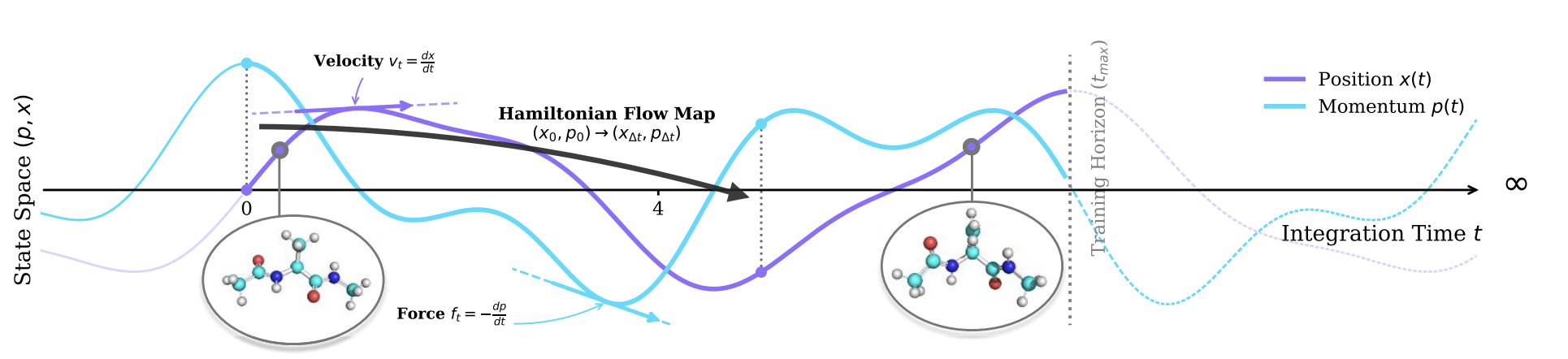
Rather than regressing future states from reference trajectories, we learn the cumulative dynamics directly from a single phase-space configuration and its instantaneous time derivative.
Background
Hamiltonian
The state at a later time
Molecular Dynamics
Concrete instantiation of Hamiltonian mechanics in which Hamiltonian is separable ie
Equation of motion reduces to
Method
Model the Hamiltonian evolution directly in phase space over a finite time interval
Hamiltonian flow map
Uses Mean Flow and self-distillation
This time averaged velocity and force captures the non-trivial, integration-dependent component of the flow map.
By multiplying
Above two equations are the consistency condition, which can be used for regression objective.
Given N particles and d dimensions
Force matching: in case
Network learns to predict interatomic force.
-> self distillation across time. instantaneous force prediction is the base signal, pred at larger
Since MLFF dataset only provides molecular geometry and force labels (x, f), momenta is sampled from Boltzmann distribution
Remove center of mass drift by ensuring
Ensure the kinetic energy stays the same after drift removal by rescaling momenta
Appendix B3: Coupled Conservation Filter set such that the corrected momenta is as close to the model's predicted momenta as possible, while
- Angular momentum conservation: the total angular momentum
is conserved. - Energy conservation: Total kinetic energy
is conserved.